Why it exists
The first write-up is about the product: wrap Oak, plan the year, keep progress in one place. That is the design argument. It is not the reason I built it.
I built HomeSchool Hub so my autistic daughter could stay at home and study. School is a building, a timetable, a crowd, and a set of transitions that do not always fit. Home education still needs a curriculum and a week. It does not need to look like a second institution.
I am not going to write her case notes here. The useful fact for design is this: she is a real learner in a real house, and the interface has to work on a Tuesday morning, not in a portfolio.
The week has to be visible
A child should be able to see the week without asking an adult to decode it. Monday to Friday. Lessons, comfort breaks, lunch. Music practice at the end of the day if that is what the family planned.
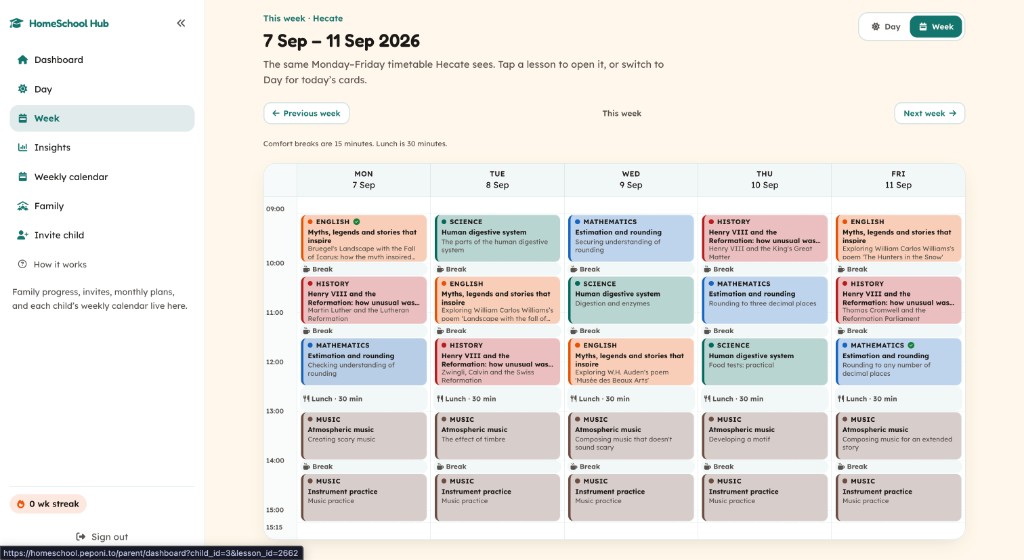
The grid is the product. If Tuesday’s science is on the calendar, she does not have to remember a list. If the break is already in the slot, the day has a rhythm instead of a pile of work. Predictable beats impressive.
One lesson, one path
Every Oak lesson in the hub has the same shape: an outcome you can read, then introduction, starter quiz, video, exit quiz. The path does not change because the subject changed.
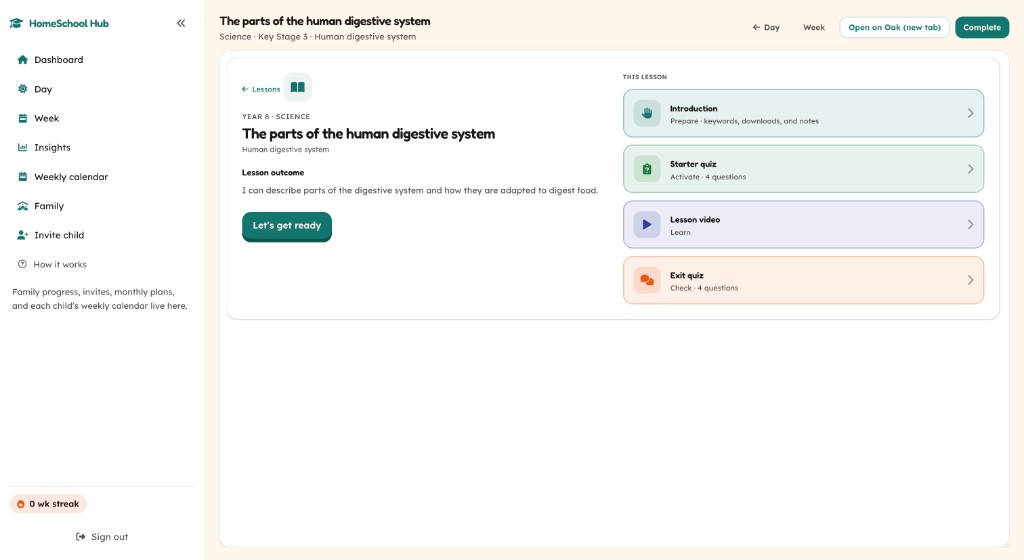
That repetition is the point. Autistic learners are often asked to adapt to a new layout every time a teacher, a platform, or a tab changes. I wanted the opposite: one shell, one order, one “what do I do next”. The content can be science on Monday and the Reformation on Tuesday. The interaction should feel like the same room.
Stay in the room
The first version of this idea was an iframe. Send the child to Oak’s site and hope they come back. That is a context switch. For some children it is also a sensory switch: new chrome, new navigation, a site that was built for a classroom tab, not a kitchen table.
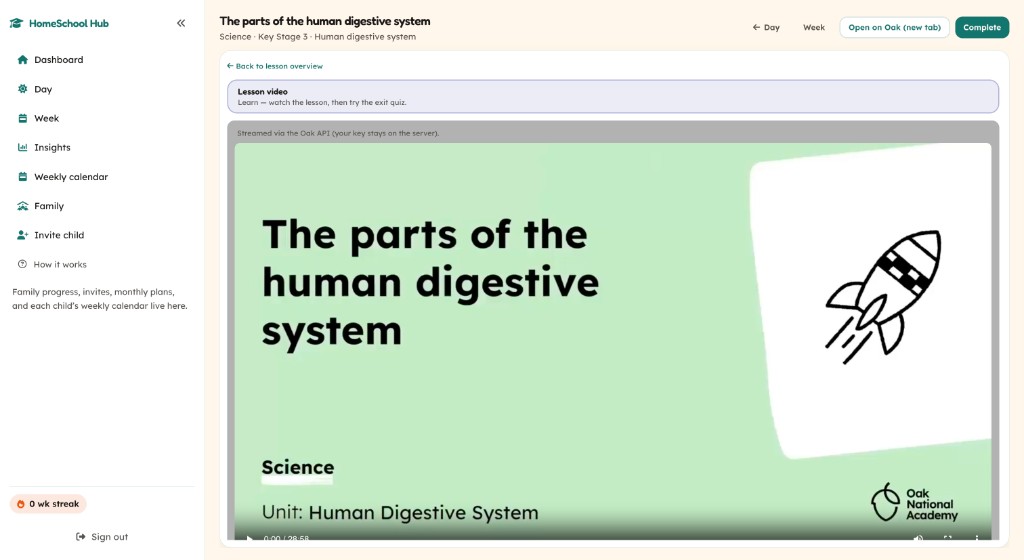
The video streams inside the hub. The child watches, then takes the exit quiz, without leaving. Oak stays the source. The hub stays the room. That is not a technical flourish. It is how you keep a school day at home from turning into a scavenger hunt.
The principle
I have spent years designing for people who have no choice but to use a service. This is the same job, closer to home. Design for the learner you have. Give the week a shape. Keep the path short. Do not send them somewhere else when they are already working.
The hub is still an experiment. The test is whether she can use it, not whether it photographs well. The live site is for our family. If you want to run your own, the landing page has the instructions. Ask Oak for an API token. They gave me one when I asked. They will give you one too.
Related
- HomeSchool Hub: a family learning space — Why wrap Oak instead of building another lesson library
- HomeSchool Hub experiment — Status, source, and what shipped